
The UK’s Riskiest Places To Work in 2026
28 min read | Posted 12 Feb 2026, Last updated 8 Jun 2026
Written by
At iHasco, we help UK businesses create safer, healthier and more compliant workplaces. As a leading provider of online health and safety training, HR compliance courses, and digital compliance training, we support thousands of organisations across high- and low-risk industries alike, from construction and manufacturing to retail, hospitality, and professional services.
For businesses, HSE data offers insights into how businesses are effectively demonstrating high standards of health and safety, compliance, and employee wellbeing within their organisation. Staff training courses, such as our Fire Safety, Health and Safety and Mental Health and Wellbeing, are vital for ensuring high standards and practices are implemented across businesses.
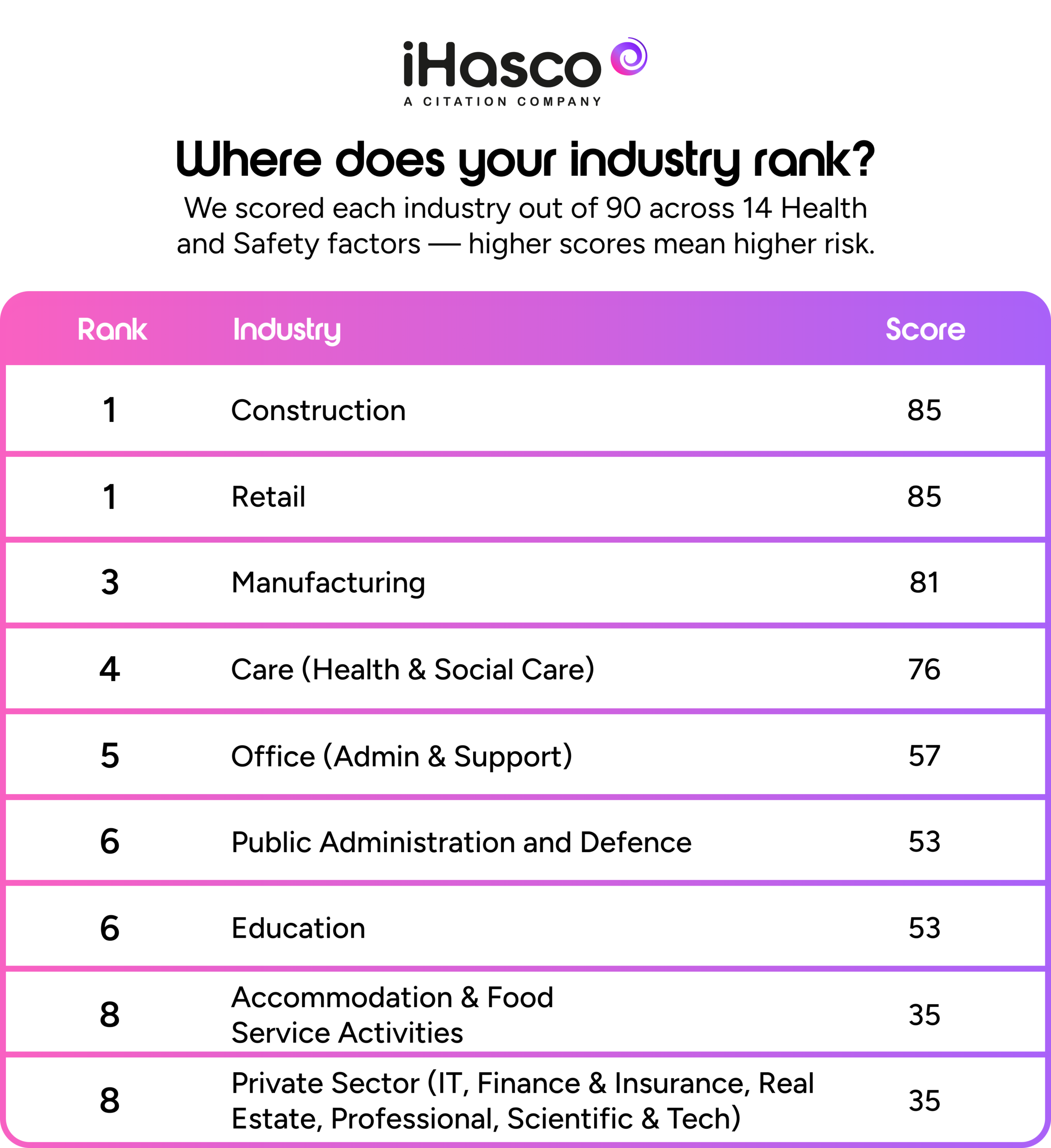
To shine a light on the current state of workplace safety in the UK, we have analysed the latest Health and Safety Executive (HSE) data alongside internal survey insights to create a UK Workplace Risk Index. This research highlights the industries and regions facing the highest levels of risk, with construction, retail and manufacturing emerging as the most concerning sectors, and Scotland ranking as the highest-risk region overall.
This report explores how risk varies across the UK, the factors contributing to higher-risk working environments, and what employers can do to better protect their people in 2026 and beyond.
Headline findings
Using our proprietary index, we analysed indicators ranging from workplace accident rates and fatal injuries to mental health-related absences and enforcement action.
The results highlight a shifting reality: workplace risk is no longer confined to traditionally dangerous jobs. Some of the most significant red flags now appear in high-volume sectors, like care and retail, alongside unexpected regional hotspots.
- Construction and Retail were identified as the riskiest industries overall.
- Manufacturing saw the highest productivity drain, losing 548,000 days to injury in 2024/25.
- The economic impact is staggering. Workplace injuries cost UK businesses an estimated £22.9 billion last year.
- Scotland emerged as the highest-risk region, with £1.6 billion in costs and the highest number of prosecutions.
A total of 40.1 million working days were lost to injury or ill-health in 2024/25.
Check your industry and region ranking
By using the interactive map below, you can find where your region and industry stand within our 2026 Risk Index:
What’s driving workplace risk?
| Industry | Number of workplace accidents (thousand) | Region | Number of workplace accidents (thousand) |
| Manufacturing | 51 | Scotland | 40 |
| Construction | 47 | North East | 68 |
| Education | 55 | North West | 69 |
| Retail | 75 | Yorkshire & The Humber | 54 |
| Care (Health & Social Care) | 79 | Wales | 24 |
| Accommodation & Food Service Activities | 44 | West Midlands | 57 |
| Public Administration and Defence | 33 | East Midlands | 52 |
| Private Sector (IT, Finance & Insurance, Real Estate, Professional, Scientific & Tech) | 20 | London | 68 |
| Office (Admin & Support) | 28 | South West | 78 |
| South East | 100 |
The data reveals a significant shift in the UK’s safety landscape. While heavy industry remains hazardous, Health and Social Care recorded the highest number of workplace accidents at 79,000, followed closely by retail at 75,000. Both sectors have now overtaken traditional high-risk environments, like Construction (47,000) and Manufacturing (51,000).
Even the Education sector, with 55,000 reported incidents, now sits higher than construction. This suggests that high-volume, public-facing roles are heading toward a safety crisis that is often overlooked in favour of building sites and factory floors. In contrast, the Private Sector — including services such as IT, Finance, and Professional Services — remains the safest, recording just 20,000 incidents.
Regional hotspots reveal unexpected trends
Geographically, risk is not found where you might expect. The South East recorded a staggering 100,000 workplace accidents, more than any other region, including the UK’s industrial heartlands.
Other notable hotspots include:
- South West (78,000) and North West (69,000) are emerging as high-risk areas despite vastly different industrial profiles.
- London (68,000) matches the North East and exceeds several traditionally industrial regions.
- Wales reported the lowest figures in the UK (24,000), standing in sharp contrast to its neighbours.
This data proves that workplace accidents are no longer concentrated solely in “dangerous” industries. The rise of risk in Care, Retail, and the South East suggests that staffing levels, high footfall, and varied enforcements are creating new safety challenges for 2026.
How many days are lost to injury?
| Industry | Days lost to injury 24/25 |
| Manufacturing | 548 |
| Construction | 429 |
| Education | 252 |
| Retail | 433 |
| Care | 546 |
| Accommodation & Food Services | 101 |
| Public Administrative and Defence | 304 |
| Private Sector | 24 |
| Office | 323 |
The impact of workplace accidents isn’t just a safety concern; it’s a productivity crisis. In 2024/25, Manufacturing and Care recorded the highest number of days lost to injury, with 548 and 546 days, respectively.
Interestingly, the data shows a narrowing gap between high-tech and service industries. Retail (433 days) and Construction (429) reported remarkably similar levels of absence. For employers in the retail sector, this suggests that volume-related risks, like repetitive strain and fatigue, require the same level of attention as traditional hazards.
Even in office-based roles (323 days), the level of absence remains high, reminding us that no environment is without risk.
Mental health is playing a part in workers taking time off
| Industry | Total Days Taken off for Mental Health 24/25 |
| Manufacturing | 865 |
| Construction | 486 |
| Education | 1,700 |
| Retail | 687 |
| Care | 3,175 |
| Accommodation & Food Services | 202 |
| Public Administrative and Defence | 2,620 |
| Private Sector | 727 |
| Office | N/A |
The data on mental health-related absence reveals a real challenge for the UK’s frontline services. The Care sector reported the highest level of absence at 3,175 days, with Public Administration (2,620 days) and Education (1,700 days) following closely behind.
These figures point to a concerning trend. In sectors where the main goal is to protect and support others, the workforce itself is under immense pressure. It suggests a “self-sacrifice” culture where staff are so focused on the wellbeing of others that their own health and safety needs are being sidelined. While this commitment is admirable, it’s ultimately unsustainable and is leading to the high levels of burnout we’re seeing across the country.
It’s also interesting to look at traditionally high-risk sectors like Construction (486 days) and Manufacturing (865 days). Their lower mental health figures might not mean the risk isn’t there; instead, it could point to a cultural reluctance to talk about mental wellbeing.
For any industry — but especially those on the frontline — the big takeaway for 2026 is simple: looking after yourself is a vital part of looking after others. Acknowledging this is the first step toward creating a safer and more resilient workplace.
What are these injuries costing businesses?
It’s easy to look at health and safety as a compliance exercise, but the financial reality is hard to ignore. In total, workplace injuries cost UK businesses £22.9 billion in 2024-25. When we look closer at the industries and regions footing this bill, some clear patterns emerge
Retail businesses spent an estimated £879 million, according to HSE data, on workplace injuries last year. It’s a common misconception that retail work is “low-risk” because it isn’t a construction site, but the scale of the sector tells a different story. When you have a massive, customer-facing workforce, the cumulative impact of simple slips, trips, and manual handling errors adds up fast. In these high-volume environments, it’s often these everyday accidents, rather than one-off major events, that drive the highest cost.
From a regional perspective, Scotland stood out with HSE data revealing this region spent £1.6 billion in costs linked to workplace accidents. This is a substantial figure that suggests accidents are a widespread issue across the region’s various industries. Insights suggest that this number is linked to a higher frequency of more serious industrial incidents, which naturally carry a higher financial and human cost.
Ultimately, no industry or region is immune to the financial pressure of workplace accidents. Keeping on top of safety isn’t just about avoiding a fine; it’s about protecting your bottom line, making sure your business remains resilient and protecting people from harm.
Workplace convictions and enforcements: The HSE is taking action
| Industry | Number of prosecutions (24/25) | Region | Number of prosecutions (24/25) |
| Manufacturing | 71 | Scotland | 33 |
| Construction | 98 | North East | 13 |
| Education | 6 | North West | 30 |
| Retail | 17 | Yorkshire & The Humber | 19 |
| Care (Health & Social Care) | 5 | Wales | 10 |
| Accommodation & Food Service Activities | 2 | West Midlands | 21 |
| Public Administration and Defence | 9 | East Midlands | 10 |
| Private Sector (IT, Finance & Insurance, Real Estate, Professional, Scientific & Tech) | 5.25 | London | 10 |
| Office (Admin & Support) | 6 | South West | 10 |
| South East | 14 |
When things go wrong, the HSE has the authority to step in. Our index shows that regulatory activity is very much on the rise, but the focus isn’t always where you’d expect. Understanding why a business might face a conviction, and how to avoid it, is key to protecting both your staff and your reputation.
Construction remains the most heavily scrutinised industry, with 98 prosecutions across 2024 and 2025 — Manufacturing isn’t far behind with 71. This isn’t surprising given the high-risk nature of these sectors, but it does show that the HSE is keeping a very close eye on industrial and operational sites.
Interestingly, despite the high number of incidents we saw earlier in the Care and Education sector, their prosecution levels are much lower (5 and 6, respectively). This could suggest a scrutiny gap — while accidents are happening, they aren’t always leading to the same level of legal action as a site-based incident.
However, for any business, a prosecution is a serious situation. It often stems from a material breach of the law, including things like failing to conduct a proper risk assessment, using unsafe equipment, or ignoring previous warnings.
Regional focus
Regionally, Scotland stands out with 33 prosecutions, the highest in the UK. Even with a smaller population than most regions, the level of legal action here is high. This reinforces the idea that in certain parts of the UK, the regulator is particularly proactive in holding businesses accountable.
The role of enforcement notices
| Industry | Number of Enforcement Notices (24/25) | Region | Number of Enforcement Notices (24/25) |
| Manufacturing | 15,106 | Scotland | 2,376 |
| Construction | 8,184 | North East | 1,250 |
| Education | 211 | North West | 4,033 |
| Retail | 1,377 | Yorkshire & The Humber | 2,315 |
| Care (Health & Social Care) | 168 | Wales | 2,069 |
| Accommodation & Food Service Activities | 87 | West Midlands | 3,092 |
| Public Administration and Defence | 276 | East Midlands | 2,415 |
| Private Sector (IT, Finance & Insurance, Real Estate, Professional, Scientific & Tech) | 856.5 | London | 3,711 |
| Office (Admin & Support) | 562 | South West | 2,615 |
| South East | 4,008 |
Before a case even reaches the courtroom, businesses often receive something called an Enforcement Notice. These are essentially a formal notice that something isn’t right. There are two main types:
- Improvement notices — You’re given a set amount of time to fix a specific problem that’s been reported.
- Prohibition notices — These are more serious and mean you must stop a specific activity immediately because there’s a risk of serious injury.
Manufacturing received a huge 15,106 notices last year, but Construction also saw a high number with 8,184. Regionally, the South East (4,008) and the North West (4,033) were top of the list.
It’s worth noting that while there’s often talk of a North/South divide in the UK, the HSE’s activity doesn’t really follow that pattern. Instead, enforcement seems to follow the concentration of industry and high-volume workplaces.
Why does it matter?
A conviction or even an enforcement notice isn’t just a legal headache; it’s also a reputational one. In a world where safety records are often public and required for tenders or contracts, a poor history can lead to a loss of clients and talent.
Staff want to work for employers who take their safety seriously, and a clear, proactive approach to health and safety procedures is the best way to make sure you never end up on the wrong side of an HSE report.
Why businesses need to keep on top of H&S procedures and training
Investing in proper Health & Safety training does more than just tick a legal box:
- It protects your team and your schedule — Good training directly reduces the risk of accidents. Fewer injuries mean your team stays safe, and your day-to-day work isn’t interrupted by the chaos of unplanned downtime.
- Your bottom line is shielded — Poor safety leads to costly absences, insurance hikes, and potential compensation claims. By being proactive, you’re effectively protecting your business from these avoidable financial drains.
- It helps you stay ahead of the regulator — Regular training helps you avoid the stress of HSE inspections and the heavy fines that come with non-compliance.
- You build a culture that people want to join — When employees see you’re genuinely invested in their safety, it builds trust. A safe workplace is a major draw for talent and a key driver for keeping the great people you already have.
A look at the numbers: Who’s leading the way for training?
Our data shows some interesting trends in how different industries are approaching their training. Between May 2024 and November 2025, a total of 7,047 courses were completed through iHasco.
| Industry | H&S course completions (24/25) | Region | H&S course completions (24/25) |
| Manufacturing | 1439 | Scotland | 353 |
| Construction | 1863 | North East | 209 |
| Education | 1375 | North West | 610 |
| Retail | 440 | Yorkshire & The Humber | 507 |
| Care (Health & Social Care) | 1459 | Wales | 269 |
| Accommodation & Food Service Activities | 471 | West Midlands | 552 |
| Public Administration and Defence | 0 | East Midlands | 478 |
| Private Sector (IT, Finance & Insurance, Real Estate, Professional, Scientific & Tech) | 0 | London | 1178 |
| Office (Admin & Support) | 0 | South West | 1914 |
| South East | 819 |
Construction took the top spot, which makes sense given the high-risk nature of the work. But seeing Care and Education so high up on the list shows that these sectors are starting to take their unique safety challenges much more seriously.
It’s also interesting to see the regional split. The South West is currently leading the pack with 1,914 completions, nearly double the next closest region, London (1,178).
Nathan Pitman, Managing Director at iHasco explains, “As we battle through the cold, dark months, having robust procedures in place is more important than ever. Slips and trips increase in winter, and the strain on staff — both physical and mental — often peaks.”
“We’re seeing businesses that treat training as a continuous part of their routine, rather than a once-a-year scramble, are the ones who feel most confident in their safety culture.”
Tips for businesses struggling to keep on top of H&S procedures
If the data reveals anything, it’s that workplace safety is a constantly evolving target. If you’re finding it a struggle to keep up with changing risks and regulations, here are three ways to simplify your approach:
1Make health and safety bite-sized and routine
Don’t treat health and safety like something to look at once a year before an audit. The most successful businesses make it a part of their weekly or monthly routine.
- The 15-minute rule — Create simple monthly checklists that take no more than 15 minutes to complete.
- Rotate the load — Give different team members responsibility for inspections, log updates, and more.
- Centralise your evidence — Keep all your records in one place. When the HSE or an auditor asks for proof, you won’t be hunting through old emails or paper files.
2. Assign clear ownership and accountability
Safety shouldn’t be someone else’s job; it’s everyone’s responsibility. It works best when there is clear ownership for specific areas, such as fire safety, first aid, or mental health and wellbeing.
- Set clear goals and timings for each owner.
- Make sure there is real-time visibility so leadership can see at a glance that the business is compliant and protected.
3. Use the right tools to ease the pressure
Managing training manually is a massive administration drain. Using a dedicated platform like iHasco helps take the weight off your shoulders.
- Automate the boring stuff — From sending out training reminders to tracking progress, technology can handle the admin for you.
- Stay current — Regulations change, and using a third-party tool makes sure that your training content is always up to date and legally sound.
Empower your staff — Clear, engaging guidance means your team actually understands the “why” behind the procedures, making them more likely to follow them.
Businesses are looking ahead to the key priorities for 2026
Understanding the data from the past year is vital, but what really matters is how businesses are preparing for the future. To find out, we surveyed our own customer database to identify the concerns of UK business leaders as we start 2026.
The top 10 H&S priorities for 2026
| Priority | % |
| Mental health and workplace stress (e.g. burnout, workload pressure) | 57% |
| Manual handling and lifting injuries | 31% |
| Workplace wellbeing culture (leadership, communication, safety engagement) | 31% |
| Slips, trips, and falls in the workplace | 29% |
| Fire safety and emergency preparedness | 29% |
| Ergonomics and musculoskeletal issues (e.g. back, neck, or posture problems from desk or manual work) | 23% |
| Construction or site-specific hazards (for those in relevant industries) | 17% |
| Exposure to hazardous substances (e.g. chemicals, dust, fumes, cleaning products) | 17% |
| Health effects of sedentary work | 11% |
| Lone working or remote work safety | 11% |
The results show a clear shift in focus. While traditional physical hazards are still high on the agenda, mental health and workplace stress have become the number one priority for a majority of employers.
It’s also telling that over half (57%) of businesses now view mental health as their primary safety concern. This matches the absence data we saw earlier and suggests that employers are moving away from a “hard hats only” mindset. They’re increasingly focused on workplace wellbeing culture (31%), making sure that leadership and communication are just as robust as the physical safety equipment on site.
The good news is that this proactive planning is clearly paying off. When we asked businesses how they felt about their current safety climate, the response was overwhelmingly positive. On average, respondents scored their confidence in their employer’s H&S procedures at 7.94 out of 10.
Pitman continues, “It’s incredibly encouraging to see that UK businesses are no longer just looking at Health and Safety as a reactive measure, but as a proactive strategy for 2026.”
“The fact that confidence levels are sitting at nearly 8 out of 10 shows that when you invest in clear processes and quality training, it filters down through the whole organisation. By tackling more modern challenges like burnout and mental health alongside traditional hazards like manual handling, businesses are creating a more resilient, safer environment where people actually want to work.”
Redefining workplace safety for 2026
The data from our 2026 Risk Index is a clear wake-up call. When H&S procedures and staff wellbeing are sidelined, the results are serious injuries, high absence rates, and a damaged reputation. This creates a cycle of staff turnover and lost client trust that is difficult to reverse.
However, workplace safety doesn’t have to be a daunting task. By using things like weekly or monthly training and clear procedures, businesses can turn complex compliance into a simple, daily habit. In 2026, a proactive safety culture is the best way to protect your people, your bottom line and your future.
Explore our range of Health and Safety training courses today to see how we can help you build a safer, more resilient workplace.
Methodology
We conducted an extensive data analysis in 2025 to identify the riskiest workplaces of 2026. By combining the latest Health and Safety Executive (HSE) data, and internal iHasco training metrics, we have created a definitive Risk Index. Each industry was scored out of 9 across various hazard categories, while regions were scored out of 10 to provide a clear picture of where risk is most concentrated. We also looked beyond the raw numbers, commissioning an internal survey of our client database to identify the top health and safety concerns for the year ahead.

James Kelly
Senior Scriptwriter
James Kelly is a senior scriptwriter who specialises in turning complex topics into clear, engaging training with a narrative-driven approach.
View James's profile