
The UK Workplace Respect Gap: What happens when inappropriate behaviour occurs?
19 min read | Posted 5 Oct 2026
Written by
Across the UK, there is a gap between what employees understand about respectful behaviour and what happens when that understanding is put into practice.
Most UK workers know what inappropriate behaviour looks like but when it happens in the workplace, a different picture emerges.
To better understand the scale of this issue, we surveyed 1,000 UK employees to explore:
- The current awareness and understanding of what constitutes inappropriate behaviour
- Employees experiences of inappropriate behaviour at work and reporting it
- How employees view their workplace culture
- The UK’s confidence in their employers when it comes to dealing with issues surrounding inappropriate behaviour
- The uptake of training and prevention of inappropriate behaviour and sexual harassment in the workplace
The findings revealed a Workplace Respect Gap – a disconnect between recognising inappropriate behaviour and feeling able to report, challenge and prevent it.
This is also reflected in wider UK research. The CIPD found that 81% of employers believe they are doing enough to prevent and manage bullying and harassment, yet just 36% of employees who had experienced workplace conflict said it had been fully resolved.
Key Findings
- 95% of workers feel very or fairly confident they could identify sexual harassment in their workplace
- 48% have experienced or witnessed inappropriate workplace behaviour
- 40% don’t fully know their employer’s procedure for reporting inappropriate behaviour
- 66% don’t have full confidence that employees who report inappropriate behaviour are adequately protected
- 57% haven’t received sexual harassment awareness training within the last two years
The issue isn’t necessarily that employees don’t recognise inappropriate behaviour. The bigger question is what happens next.
The Awareness Gap: Do employees know what inappropriate behaviour looks like?
UK workers appear broadly confident in recognising inappropriate behaviour and sexual harassment, so the awareness gap isn’t about widespread ignorance.
According to our data, almost three-quarters (72%) of workers believe that all of the behaviours listed in our survey could constitute inappropriate workplace behaviour. This covered anything from sexual behaviours such as inappropriate touching and sexual jokes to more malicious behaviours such as unjustified criticism, spreading rumours and aggressive emails.
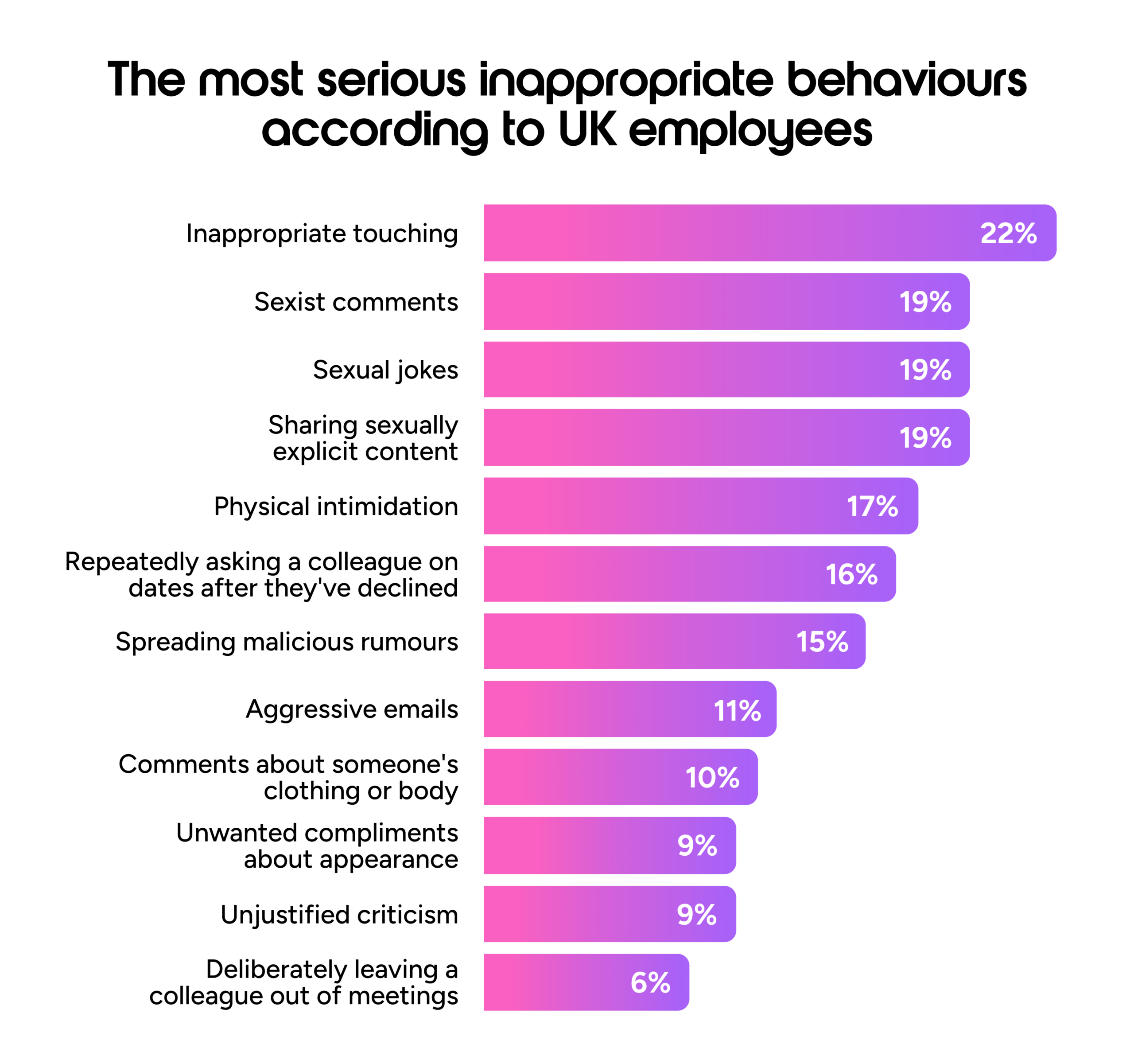
Outside of the 72% of respondents who believed all behaviours listed to be inappropriate, the most serious behaviours considered were:
- Inappropriate touching (22%)
- Sexist comments (19%)
- Sexual jokes (19%)
- Sharing sexually explicit content (19%)
- Physical intimidation (17%)
There is a particularly high level of awareness when it comes to sexual harassment. A striking 95% of workers say they are very or fairly confident that they could identify sexual harassment if it happened in their workplace.
Do employees know how to respond to inappropriate behaviour?
However, recognising a problem and knowing what to do about it aren’t the same thing.
When asked whether they know their employer’s policy for reporting inappropriate behaviour, only 60% said they do. A further 27% said they know it somewhat, while 9% don’t know it, and 4% aren’t sure whether their employer has a reporting procedure.
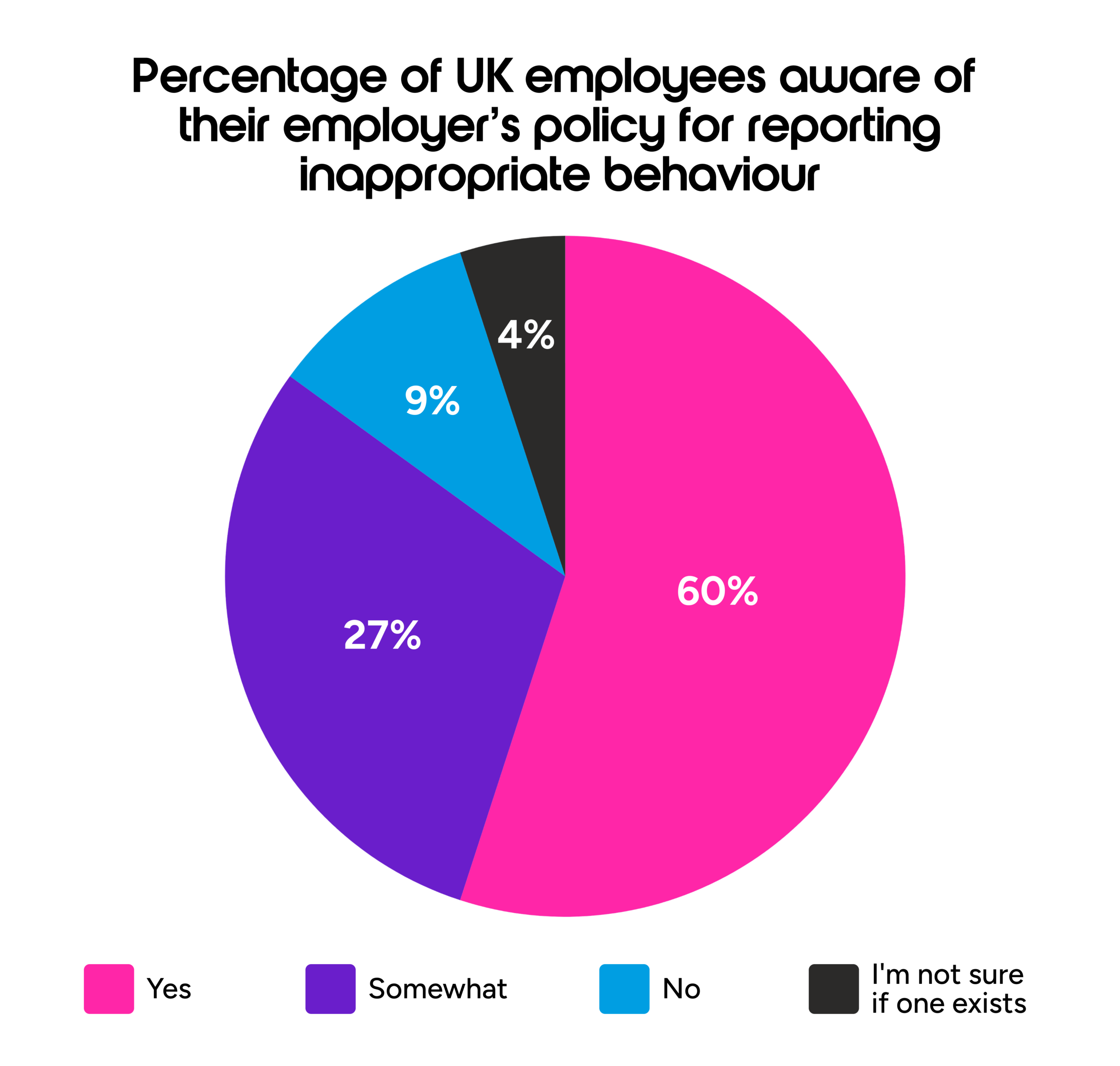
With 40% of workers not having full knowledge of their employer’s reporting procedure, this is where the awareness gap becomes apparent. An employee may know that a comment, joke, or unwanted behaviour crosses a line, but still be uncertain about what happens next and how to deal with it.
Inappropriate behaviour isn’t always as obvious as physical contact or an unwanted sexual advance. The WORLD Policy Analysis Center’s international data highlights the distinction between sexual behaviour-based harassment and sex-based harassment, with the latter including behaviours such as gender stereotyping and derogatory jokes.
Its data shows that only 96 countries explicitly prohibit both types of workplace harassment, showing awareness needs to cover more than the most obvious examples.
Employees need to understand the wider spectrum of inappropriate behaviour and, crucially, know what they can do when they encounter it. This is why company-wide training and education is crucial to develop an understanding of not just what inappropriate behaviour is, but also how to report and prevent it.
Reflecting on the findings, Nathan Pitman, Managing Director at iHasco, says employers should look closely at how practical their reporting policies are for employees.
“Employers should look at their reporting process from an employee’s point of view. If somebody experiences or witnesses inappropriate behaviour, they shouldn’t have to search through lengthy documents to try and work out who they’re supposed to speak to.
“A good policy should make the next steps simple. Employees should be able to quickly understand who they can raise a concern with, how to do it and where to find the information they need. The easier that process is to understand and access, the less uncertainty there is at a point when someone may already feel uncomfortable about speaking up.”
The Reporting Gap: Why do employees stay silent?
Knowing that something is inappropriate doesn’t necessarily mean an employee will report it.
Almost half (48%) of workers surveyed have experienced or witnessed inappropriate workplace behaviour. Of those, 29% reported it, while 18% decided against reporting it.
So why do people stay silent?
The most common reason was a desire to avoid conflict at work, given by 25% of those who didn’t report. Another 15% believed nothing would happen, while 11% feared retaliation. A further 11% didn’t think the behaviour was serious enough to report.
Wider research tells a similar story. The 2025 Civil Service People Survey found that only 41% of civil servants who had experienced bullying or harassment said they reported it. Among those who did report their experience, 57% used less formal means, 35% confided in someone, and only 20% raised a formal complaint.
A reporting policy on paper isn’t enough if employees think speaking up will cause conflict, achieve nothing or leave them exposed to retaliation.
How does this vary across the UK?
There are notable differences between regions.
Scotland had the highest proportion of workers who experienced or witnessed inappropriate workplace behaviour but didn’t report it, at 25%. By comparison, the figure was just 5% in the North East.
The South West also stands out for its high level of exposure to inappropriate behaviour. Only 34% of workers there said they hadn’t experienced or witnessed inappropriate workplace behaviour. Meanwhile, 40% experienced or witnessed it and reported it, while a further 23% experienced or witnessed it but didn’t report it.
For example, 64% of employees had experienced or witnessed inappropriate behaviour in the South West, in comparison to 39% in Wales, which could be down to different regions having different industry mixes.
The Protection Gap: Do workers trust what happens when somebody speaks up?
Even when employees know how to report inappropriate behaviour, they need to believe that doing so will result in fair treatment and adequate protection.
Only 34% of workers believe employees who report inappropriate behaviour are adequately protected. A further 38% say employees feel they are only protected sometimes, while 18% say they don’t feel protected at all, and 11% are unsure.
Global Policies
Internationally, the WORLD Policy Analysis Center data illustrates how protection can vary significantly. Its research found that 95 countries provide comprehensive legal protection against any adverse action for employees who report workplace sexual harassment. A further eight provide protection against harassment or disciplinary action, while 12 protect against dismissal only.
40% say senior leaders actively promote respect and take inappropriate behaviour seriously, while another 34% say they mostly do.
Yet 35% have frequently or occasionally seen inappropriate behaviour dismissed, excused or downplayed.
There are gender differences in confidence, too. While 46% of men are very confident that their employer would investigate a sexual harassment complaint fairly, the figure for women is 39%.
Similarly, 51% of men are very confident reporting sexual harassment themselves, compared with 42% of women.
UK workplace conflict outcomes
Wider UK research reinforces the importance of what happens after an issue is raised. Acas found that around half of the people who experienced workplace conflict said it was largely or fully resolved, but 31% said it was mainly or completely unresolved, while 19% took no action.
The Civil Service People Survey provides another useful comparison. Among civil servants who reported bullying or harassment, only 27% said appropriate action had been taken, while 38% said the behaviour had stopped.
Nathan adds,
“Having a policy on paper isn’t enough; what happens after an employee speaks up defines your culture. Unresolved conflict usually stems from unprepared management, so start with three clear steps: set explicit responsibilities before issues arise, map out a clear escalation path, and provide managers with practical training to hold confident, constructive conversations. When you prepare your leaders in advance, they can act with clarity in the moment, ensuring your people feel heard, supported, and protected.”
The Training Gap: Are UK workers receiving enough workplace training?
Training is another area where employees’ expectations and experiences don’t match up.
Most workers believe training can make a difference, with 71% saying workplace training is very or somewhat effective at preventing inappropriate workplace behaviour.
But despite this confidence in training, most workers haven’t received recent sexual harassment awareness training.
Just 38% definitely received sexual harassment awareness training within the last two years. More than half (57%) haven’t, while 4% are unsure, suggesting there needs to be stronger communication and clarification if and when training is taking place.
This comes despite signs that employers are placing greater emphasis on the issue. In 2025, iHasco recorded a 1,213% year-on-year increase in the use of its Sexual Harassment Awareness training, making it the company’s most-used corporate training course.
While this suggests demand for training is growing, the latest findings show there is still a significant gap in the number of employees who report receiving it.
The Culture Gap: How respectful are UK workplaces really?
On the surface, the picture of workplace culture is broadly positive.
More than three-quarters (78%) of workers describe their workplace as very or mostly respectful, while 81% personally feel very or fairly respected.
But those figures sit alongside evidence that inappropriate behaviour is still being witnessed and, in some cases, dismissed.
Almost one-third (32%) say they frequently or occasionally witness inappropriate workplace behaviour. Meanwhile, 35% frequently or occasionally see inappropriate behaviour dismissed, excused or downplayed.
How workplace respect is experienced and perceived
Women are more likely than men to say they frequently or occasionally witness inappropriate workplace behaviour: 35%, compared with 28% of men.
Women are also more likely to believe workplace respect is getting worse, with 17% of women thinking respect in UK workplaces is getting worse, compared with 11% of men.
By contrast, 39% of men believe workplace respect is improving, compared with 32% of women.
The types of behaviour women experience may shape perceptions of whether workplace culture is improving overall. Some inappropriate behaviour could have previously been dismissed as “banter” or treated as relatively minor, but growing awareness of what constitutes inappropriate conduct may make employees less willing to accept them as simply part of workplace culture today.
Petra Martins, HR Business Partner at iHasco, explains that intent and impact don’t always align when it comes to workplace behaviour.
“Something can be said or done without the intention of making someone uncomfortable, but that doesn’t mean it won’t have that impact. A joke or comment that one person considers harmless could make somebody else feel excluded, uncomfortable or disrespected.
“We also need to recognise that expectations around workplace behaviour change over time. Words or actions that previously went unchallenged can be viewed differently today as people become more aware of how certain behaviours affect their colleagues.
“For employers, the question is whether they’re fostering a culture where people feel comfortable speaking up and respectful behaviour is demonstrated at every level. That means managers leading by example, encouraging open communication and making sure employees can raise concerns or give feedback without feeling that they’ll simply be dismissed.
“A respectful workplace shouldn’t exist only in policies and procedures. Employees need to see those values reflected in their day-to-day lives, whether that is how people communicate or how managers respond when concerns are raised.”
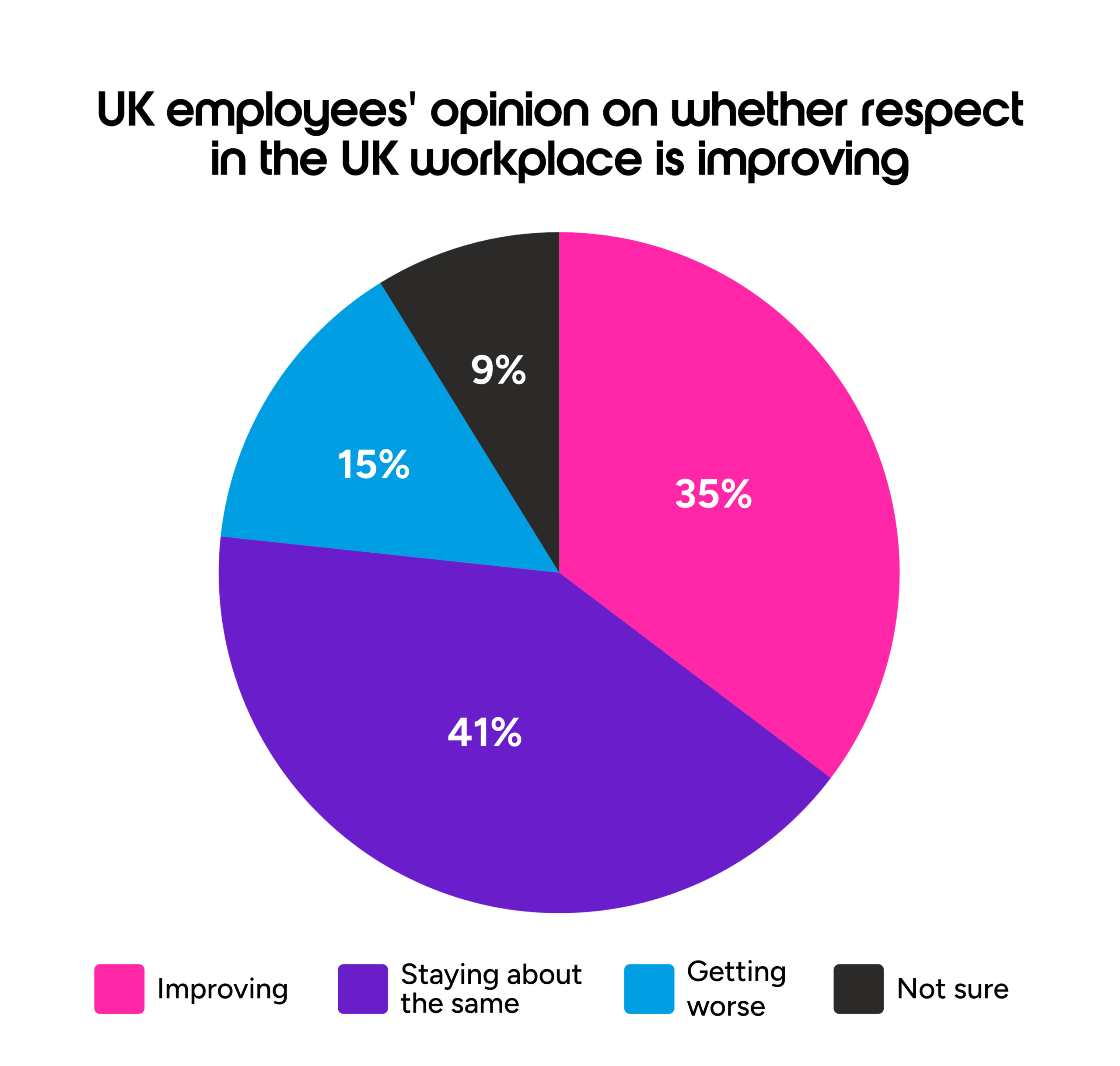
Looking ahead, the overall picture is mixed. 35% of workers think workplace respect is improving, while 41% believe it is staying about the same. 14% think it is getting worse.
Feeling personally respected is clearly important, but it doesn’t automatically mean an organisation has actively created a culture where inappropriate behaviour is rare, recognised or consistently challenged.
Recent changes to employment law have placed greater emphasis on prevention, rather than simply responding when something goes wrong. From 30th October 2026, the Employment Rights Act 2025 will further strengthen this, requiring employers to take all reasonable steps to prevent inappropriate behaviour, specifically sexual harassment.
How does the Workplace Respect Gap differ by industry?
There isn’t one single “worst” industry when it comes to workplace respect. Instead, the survey reveals different challenges across various sectors.
The reporting challenge in healthcare
According to our data, healthcare workers are less likely to report inappropriate behaviour when they see it.
- Almost a quarter (24%) experienced or witnessed inappropriate workplace behaviour but didn’t report it, the highest proportion among the industries analysed.
- A further 29% experienced or witnessed inappropriate behaviour and did report it, meaning 54% encountered inappropriate workplace behaviour overall.
- Among healthcare workers who didn’t report inappropriate behaviour, 20% said they wanted to avoid conflict, while 17% believed nothing would happen if they did report.
The findings suggest that confidence in reporting procedures, rather than their existence alone, may be an issue for healthcare employers.
Hospitality: visible behaviour and lower confidence
Hospitality presents a different combination of challenges.
- Workers in this sector are more likely to witness inappropriate behaviour frequently, with 22% saying they do so – the highest proportion among the industries analysed.
- A further 16% frequently see inappropriate behaviour dismissed, excused or downplayed.
- At the same time, just 29% are very confident that their employer would investigate a sexual harassment complaint fairly, which is the lowest proportion among the industries analysed.
Together, this data points to challenges around both workplace culture and confidence in how complaints are handled.
The training gap in Construction
The main finding for construction relates to training rather than suggesting that construction workplaces are inherently less respectful.
- Over three-quarters (76%) of construction workers haven’t received sexual harassment awareness training within the last two years, the highest proportion among the industries analysed. Only 24% say they have received recent training.
- As highlighted, construction workers also have the highest proportion saying workplace training is “not very effective” at preventing inappropriate behaviour, at 32%.
Education: a comparatively positive picture
Education provides a useful contrast.
- 86% of education workers describe their workplace as very or mostly respectful. Just 2% frequently witness inappropriate workplace behaviour, the lowest proportion among the industries analysed.
- Leadership perceptions are also comparatively positive, with 52% saying senior leaders actively promote a respectful workplace and take inappropriate behaviour seriously.
These findings suggest the Workplace Respect Gap isn’t equally pronounced across every sector, with different workplaces facing different challenges
How can employers close the Workplace Respect Gap?
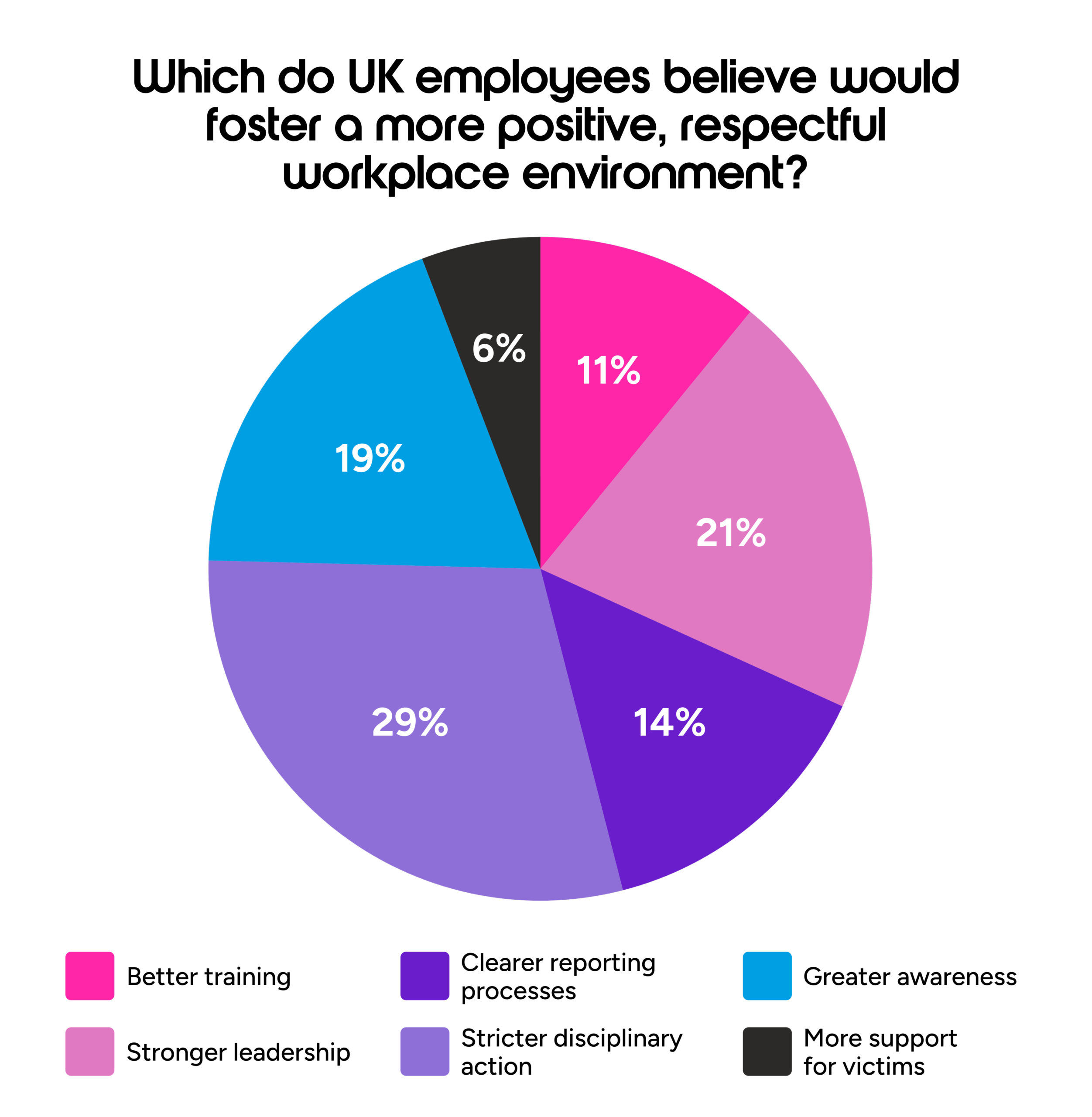
Workers were asked what they believe would create a more respectful workplace. The most popular response was stricter disciplinary action, selected by 29%, followed by stronger leadership at 21%.
Following on from that, others believed the greatest impact would be from:
- Greater awareness (19%)
- Clearer reporting processes (14%)
- Better training (11%)
- More support for victims (6%)
To close the Workplace Respect Gap, organisations need to work across all five areas:
- Awareness: make sure employees understand the full range of inappropriate behaviours and know what to do when they see them.
- Reporting: provide clear, accessible routes for raising concerns.
- Protection: give employees confidence that speaking up won’t leave them exposed.
- Training: make training regular, relevant and engaging rather than treating it as a tick-box exercise.
- Culture: make sure that leaders model respectful behaviour and that inappropriate conduct is challenged consistently.
There is also a role for bystanders. A respectful workplace isn’t created solely by the person experiencing inappropriate behaviour or the manager responsible for dealing with a complaint. Employees at every level can contribute to a culture where inappropriate behaviour is recognised and challenged.
How to take action and close the gap
Workplace respect isn’t defined by the policies an organisation has on paper. It’s defined by whether employees understand those policies, trust them and, most importantly, see them working in practice.
For employers looking to close that gap, effective workplace training is an important place to start. iHasco provides accessible, video-led workplace training designed to make learning simple, engaging and practical, helping organisations build the knowledge and awareness their people need to work safely and respectfully.
Find out how iHasco can help your organisation build a stronger culture of workplace respect with simple, effective online training.

Hugh Gray
Content Developer